3284: Geology Building
| Geology Building |
 Title text: The administration thinks it's weird, but the geologists say it looks normal. |
Explanation[edit]
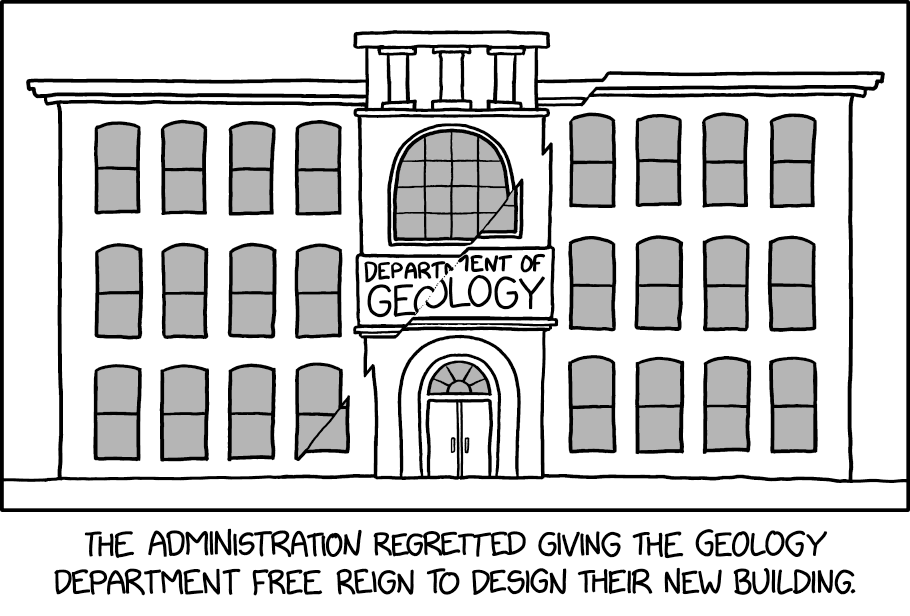
The comic depicts a university building which houses the geology department. The design of the front deviates from a standard rectangle, with all boundaries on the left side of a diagonal line through the middle shifted slightly down and left along that boundary. This mimics the motion of a normal fault plane between two parts of Earth's crust. The caption indicates that the geology department designed their own building, and chose to add an apparent fault plane as part of the architecture. Other university buildings have incorporated humorous subject related designs into their architecture.
Since the department's design affected key parts of the building, like windows and roofing, it might extend throughout the whole building. If the fault was formed the way geological normal faults form — with the hanging wall settling diagonally downward due to the extension of the underlying tectonic plate — this would rupture water pipes and electrical wires in the walls, and even undermine the integrity of the building by introducing discontinuities in the building's framing. If, instead, the building was built with the fault plane as part of the layout and reinforced accordingly, it would still be impractical, disrupting the floors and doorways of individual rooms by introducing a step or ramp. It might also be the fault trace is just an aesthetic facade and the interior of the building is normal (in the non-technical sense of the word).
The title text plays on the word 'normal'. To the general public, describing a building as 'normal' would suggest that it conforms to typical architectural principles, which this building does not. In geological terms, a normal fault is typically the result of extension in a tectonic plate, like the East African Rift. This results in the hanging wall of the fault sinking diagonally downwards, creating an inclined fault line similar to the design of the building. (In contrast, a 'reverse' fault is the result of two plates sliding into each other and the overhanging plate rising up the incline made against the other plate.) This joke was also made in the title text of 1388: Subduction License.
Normal fault planes were also featured in 1874: Geologic Faults.
Transcript[edit]
- [Inside of the box, there is a building, seemingly a university, with a fault line going through it. One side is slightly more raised than the other, however this may be a illusion, as the ground is level. The fault intersects multiple windows, as well as the main sign. 3 pillars are located at the top of the building, above the main entrance.]
- Sign: Department of Geology [Text has a fault line going through]
- [Caption below the panel:]
- The Administration regretted giving the Geology Department free rein to design their new building.
Trivia[edit]
In the original version of the comic, the caption originally said "free reign", which is a common eggcorn for the correct phrase, "free rein". This mistake was later fixed.
Discussion
Should we create a category, "Comics dealing with geologic faults"? It would be big: Geologic Faults, but also Future Timeline, Geology, Subduction License, Glacial Erratic, Seismologists, Water Damage, Deposition, Heart Mountain, Holes, and of course this one. Nitpicking (talk) 02:40, 13 August 2026 (UTC)
- And Friday's, Accretionary Arc Paul1764 (talk) 19:26, 17 August 2026 (UTC)
- @Nitpicking and Paul1764, you should propose the category at the community portal (EX:CPC), it think it's a nice category! Let's see if anyone has any other comics to add. FaviFake (talk) 14:55, 18 August 2026 (UTC)
Hello comma, nice metring people here period. Reference to 3143 Ninojin3DD (talk?) 05:13, 13 August 2026 (UTC)
In the subsequent meetings over responsibility for all the leaky pipes and trip hazards, the Administration are further confused when they tell the Geologists "it's your fault", and the Geologists reply "yes, it is!" 2a0a:ef40:1605:2b01:9599:311a:ef5a:cbd4 (talk) 07:22, 13 August 2026 (please sign your comments with ~~~~)
- Hey, even the little things can have faults. 7amiþ moi · 💬 · 📊 08:20, 13 August 2026 (UTC)
- Both sides missed a trick, by not seeking naming rights for the building and its design features. If they had, then, if anyone were to ask "Whose fault is this?", they could answer "Angel Spelunker's!". Or maybe, if the university is in California's East Bay, "Hayward's!". ICYMI, for this comic IRL, see California Memorial Stadium - and, yes, yes, the Hayward is a strike/slip, not a normal, fault. 2605:59C8:160:DB08:114C:AB4F:B80D:1C3C 14:54, 13 August 2026 (UTC)
I don't know enough about this to be sure, and certainly not enough to rewrite it, but the last paragraph seems confused to me. Reading the Wikipedia article, it seems a normal fault is a type of slip fault. The horizontal fault being described seems like a strike-slip fault, but it doesn't appear that the distinction between that and a normal fault is related to whether the plates are moving towards or away form each other. 82.13.184.33 09:00, 13 August 2026 (UTC)
- I have edited the last paragraph to make it more consistent with geological fault terminology. Faults are planes. The lines we see are where the plane intersects with the Earth's surface (or a cross-section). The terminology (normal, reverse, or strike-slip) depends on the relationship between the direction of movement — the slip — and the orientation of the fault plane within the Earth. Hopefully this helps. Waldronjwf (talk) 13:45, 13 August 2026 (UTC)
- It might be worth noting in the text that "normal" as used by the geologists refers to the relative plate motion being perpendicular to the boundary between them, and away from each other. (Hence the plate on top of the diagonal fault plane falling downward; a reverse fault is when the plates move toward each other and the plate on top of the diagonal plane gets shoved upward.) But I'd feel better if someone with more knowledge of geology added that info. 163.116.145.42 14:00, 13 August 2026 (UTC)
- I will work on this as it's stuff I teach on a regular basis, but then I have a class or two to get things right! The challenge is to keep it brief enough for the format, while making sure it's both easy to understand and technically correct for geologists. One thing I will try to include is that only very few faults are actually plate boundaries. The vast majority of faults (including normal faults with just small offsets like this one) are within plates, and represent small adjustments to the much larger strains at plate boundaries. The faults everyone knows about (eg San Andreas) are plate boundaries, but there are millions of others that are not. So geologists will talk of the walls of a fault: - the block above the fault is the hanging wall and the block below is the footwall. And you are quite right that if the hanging wall is offset downwards it's a normal fault and if it moves upwards it's a reverse fault. I will craft a more complete edit in a while. Waldronjwf (talk) 16:34, 13 August 2026 (UTC)
- Without reading this first, I just made it contrast normal faults with reverse faults (as the logical opposite form). I nearly left the previous (essentially vertical) fault description, but then we perhaps have to mention other yet more different variations. ;) 92.23.0.28 19:49, 13 August 2026 (UTC)
- It might be worth noting in the text that "normal" as used by the geologists refers to the relative plate motion being perpendicular to the boundary between them, and away from each other. (Hence the plate on top of the diagonal fault plane falling downward; a reverse fault is when the plates move toward each other and the plate on top of the diagonal plane gets shoved upward.) But I'd feel better if someone with more knowledge of geology added that info. 163.116.145.42 14:00, 13 August 2026 (UTC)
I find no fault with this architectural design.--163.116.130.119 10:53, 13 August 2026 (UTC)
Back in the seventies, my sister studied civil engineering at Sunderland polytechnic in the north of England, now the University of Sunderland. She told me that the geology department was planning a new building and the engineering department and the engineering department had to point out that they were building on an unstable geological formation, the only one in the north of England.
I visited Castle Ward in Northern Ireland, long before it was used in Game of Thrones. It was built in the eighteenth century by a married couple who couldnen decide on an architectural style, so the front of the building is gothic with rectangular windows and the rear is Palladian, with arched windows. In the centre there are windows start rectangular and end arched.--2A00:23CC:D248:8901:8D01:BEFC:F107:232E 15:24, 13 August 2026 (UTC)
Here's the Department of Earth Sciences at Oxford street view. Apparently it was designed by the faculty. Bertbeerpot (talk) 07:53, 14 August 2026 (UTC)
At Queen's University while I was there, the chemistry building had a somewhat similar discontinuity between its two wings. The older wing had considerably taller floors than the new one, so (IIRC) the connection between them on the ground floor was level, new-2nd to old-2nd had a ramp up, new-3rd didn't connect to the old building, and new-4th to old-3rd had a ramp down. Or something like that. It's been a few decades... BunsenH (talk) 14:24, 14 August 2026 (UTC)
- And the new wing was demolished in 2002, and the old wing repurposed for Administration. So the discontinuity no longer exists. BunsenH (talk) 04:01, 15 August 2026 (UTC)
"Free Reign" Eggcorn
So I am puzzled by Randall today, choosing an "eggcorn" of free rein when he is ordinarily erudite and literate. Is there a subtext of punning or irony that is enhanced by this misstating of an idiom? Is Randall unaware that this is considered an error, at least by pedants? Did he just slip it in to see pedants like me go nuts about it? Elizium23 (talk) 01:42, 13 August 2026 (UTC)
- Free reign does look better though, but definitely think it could be nerd-sniping Alexylvan (talk) 03:17, 13 August 2026 (UTC)
- I think horse-related idioms are poorly understood now, because so few people actually ride or handle horses anymore: they don't even know what "champing at the bit" could be! But people still do live in monarchies and understand them, so they are more likely to understand "free reign" for all intensive porpoises. Elizium23 (talk) 04:48, 13 August 2026 (UTC)
- Nice, I like "all intensive porpoises" and didn't even notice the cetacean until I came to write this comment. Paul1764 (talk) 18:18, 13 August 2026 (UTC)
- [cetacean needed] AdmiralMemo (talk) 05:23, 14 August 2026 (UTC)
- Nice, I like "all intensive porpoises" and didn't even notice the cetacean until I came to write this comment. Paul1764 (talk) 18:18, 13 August 2026 (UTC)
- I think horse-related idioms are poorly understood now, because so few people actually ride or handle horses anymore: they don't even know what "champing at the bit" could be! But people still do live in monarchies and understand them, so they are more likely to understand "free reign" for all intensive porpoises. Elizium23 (talk) 04:48, 13 August 2026 (UTC)
- It may be a legitimate mistake on Randall's part. While the actual metaphor refers to horseback riding (letting the horse free from its rein), he might have thought it refers to a ruler letting people do do what they want. Barmar (talk) 04:25, 13 August 2026 (UTC)
- Well. I mean. I just learned today that it is "free rein" as in horses instead of "free reign" as in kings. So... 11:29, 13 August 2026 (UTC) 130.76.187.47 11:29, 13 August 2026 (UTC)
- Very surprised to see this error. What's next? "Honing in" on a target? "Allot" of problems? 2A00:23C8:F529:1301:E542:E11A:58F8:7A58 12:55, 13 August 2026 (UTC)
- At a church picnic 45 years ago, I learned about a common ingredient in Japanese cuisine: "toe food". 24.123.140.66 23:59, 14 August 2026 (UTC)
free reign
Mr. Munroe, I expected better of you. HaruruChanDesu (talk) 13:50, 13 August 2026 (UTC)
- "It would be so easy to dismiss eggcorns as signs of illiteracy and stupidity, but they are nothing of the sort. They are imaginative attempts at relating something heard to lexical material already known." Geoff Pullum, one of the inventors of the term "eggcorn," on March 22, 2004 AdmiralMemo (talk) 05:28, 14 August 2026 (UTC)
Probably worth noting that "free rein" has been corrected by the author. 2A01:E0A:AF9:6680:850F:53D6:BC15:948E 01:21, 14 August 2026 (UTC)
- I changed the explanation to mention this. An architect (talk) 02:04, 14 August 2026 (UTC)
- Could Randall be reading the explanations? Will we see a "Rein vs Reign" XKCD sometime in the future??? BorQhue del Sol (talk) 20:37, 14 August 2026 (UTC)
- Probably as likely to have been reading his Twitter comments (or X, if you insist - but as the change to that also made it unreadable for me, I'm only guessing what followups there might be there), or any other of the standard 'xkcd fan' places where a "Hey, Randall, did you know that you...!" got posted. 92.23.0.28 21:33, 14 August 2026 (UTC)
- Could Randall be reading the explanations? Will we see a "Rein vs Reign" XKCD sometime in the future??? BorQhue del Sol (talk) 20:37, 14 August 2026 (UTC)
there seem to be a lot of geologists focusing on the play on the word normal as conflating "ordinary" and "type of fault plane". I would add that as an engineer I see an additional play on words. "normal" in engineering usually refers to a right angle (perpendicular) relationship, which is not the case in any part of the building that contains the diagonal fault line. possibly another facet to the word play by Randall. -- 216.169.136.118 (talk) (please sign your comments with ~~~~)
I feel like the facade explanation should come first here. If the whole building were designed to accurately represent the results of a slip, the costs would be astronomical. The administration might have given them free reign to design, but you can bet that came with a budget limit one way or another, or the post hoc imposition of one in the face of absurdly expensive plans. An effective facade, on the other hand, would be easy, fun for the designers, probably a welcome change of pace for the builders, and would look a whole lot better on the inside, not to mention allowing far better use of space. 2601:642:4C00:D0CA:AECA:F446:6316:FE3B 12:23, 15 August 2026 (UTC) Add comment